
Understanding Property Assessment
The Property Tax System
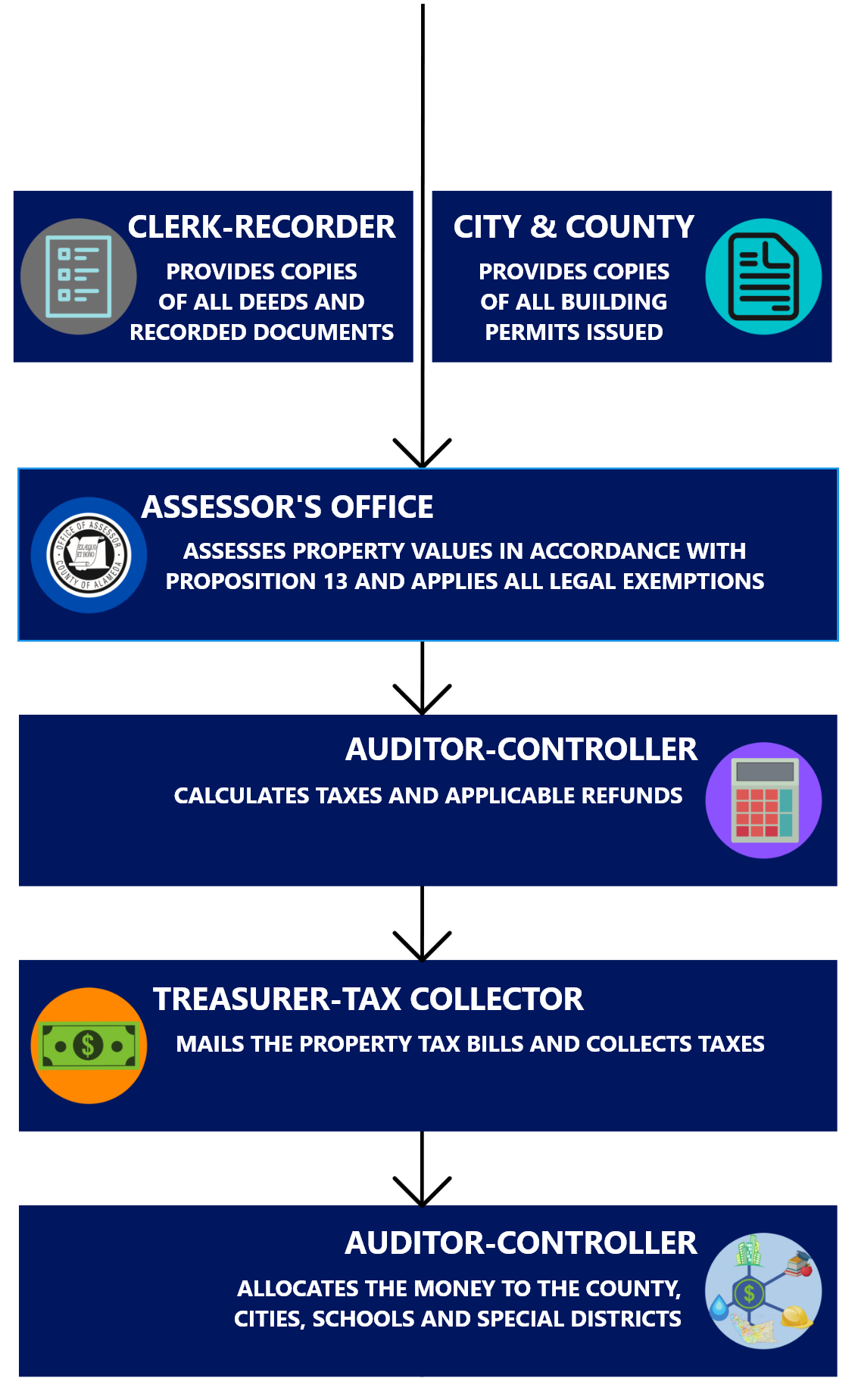
The Assessor, Auditor-Controller, and the Treasurer-Tax Collector all play distinct roles in the property tax system. Below is a brief description of how these County departments interrelate.
The Assessor
The County Assessor determines the assessed value of all taxable property within the county, maintaining records and establishing assessed values as of January 1 each year (the lien date).
The Auditor-Controller
The Auditor-Controller applies tax rates to assessed values to compute taxes owed, extends the tax roll, and apportions tax revenues to taxing agencies (cities, schools, special districts, etc.).
The Treasurer-Tax Collector
The Treasurer-Tax Collector mails property tax bills and collects payments. The first installment is due November 1 (delinquent after December 10). The second installment is due February 1 (delinquent after April 10).
Proposition 13
Proposition 13 was passed by California voters on June 6, 1978, amending the California Constitution to limit the assessment and taxation of property.
Assessment Limits
Real property is assessed at its 1975-76 base year level and cannot increase by more than 2% annually. It is reassessed at current fair market value when a change in ownership occurs or new construction is completed.
Tax Rate Limits
Property taxes are limited to 1% of taxable value, plus any voter-approved bonded indebtedness, service fees, improvement bonds, and special assessments.
Proposition 8 (Decline in Value)
The Assessor must assess real property at the lesser of its Prop 13 level or current market value as of January 1. If assessed at the lower market value, the Prop 13 assessment must be restored when market value recovers.
Business Personal Property
Business personal property is assessed at fair market value as of January 1 each year, not subject to the Prop 13 base year value system.
Why Assessed Value May Increase More Than 2%
The Assessor annually enrolls either a property’s Prop 13 value (factored by no more than 2%) or its current market value on January 1, whichever is less.
Proposition 8 Restoration
Prop 8 assessments are temporary reductions. As the market recovers, values are increased back to the Prop 13 level. These increases are not subject to the 2% limitation.
Other Reasons
- Change in Ownership: Reassessed at current market value when sold or transferred.
- New Construction: Additions or new structures assessed at current market value.
- CPI Adjustment: Prop 13 values may increase up to 2% per year.
For historical information about Proposition 13 and an overview of property tax assessment, view the Proposition 13 Property Tax Overview Brochure (PDF – Archived Publication 29) published by the State Board of Equalization.